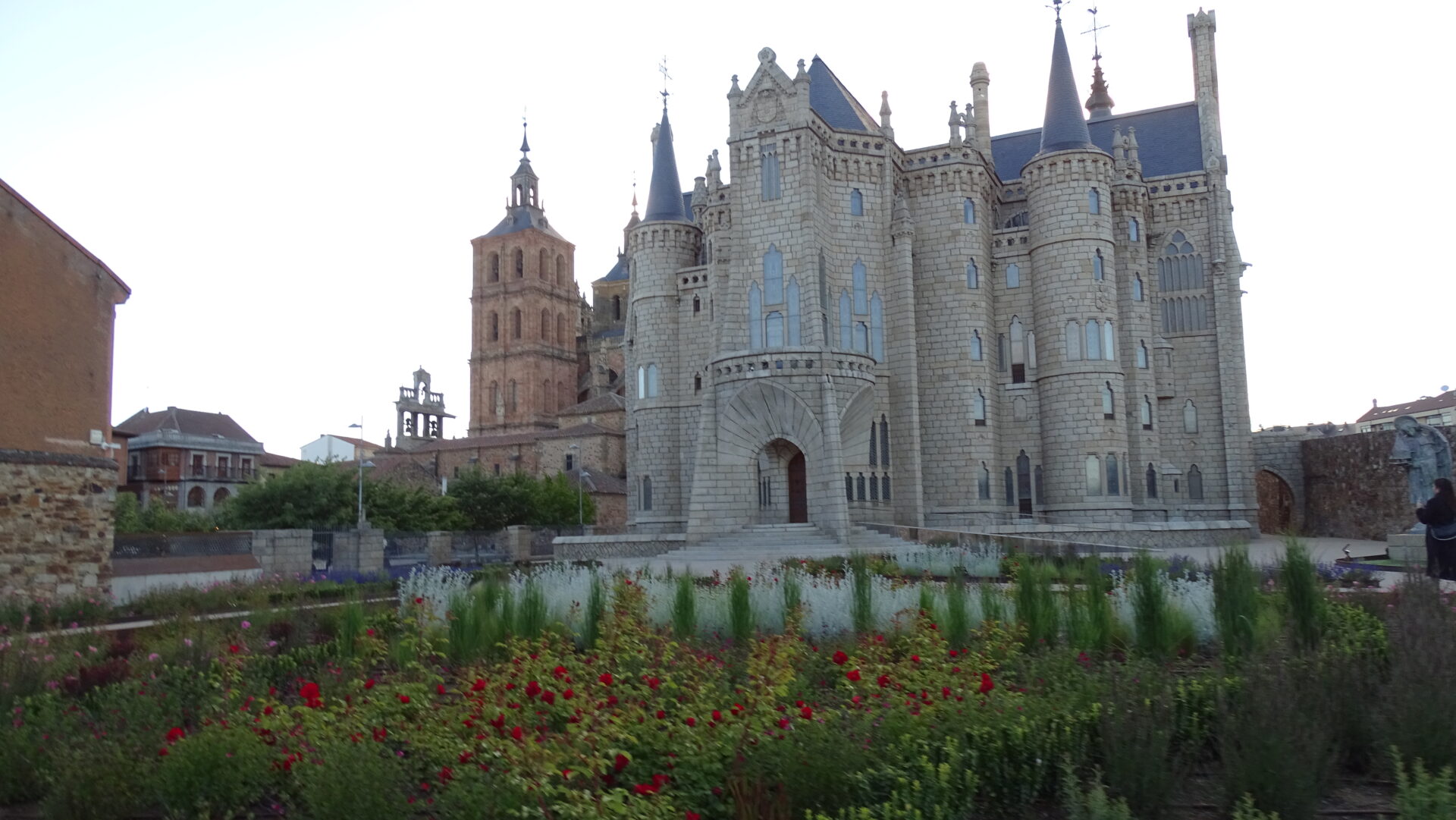
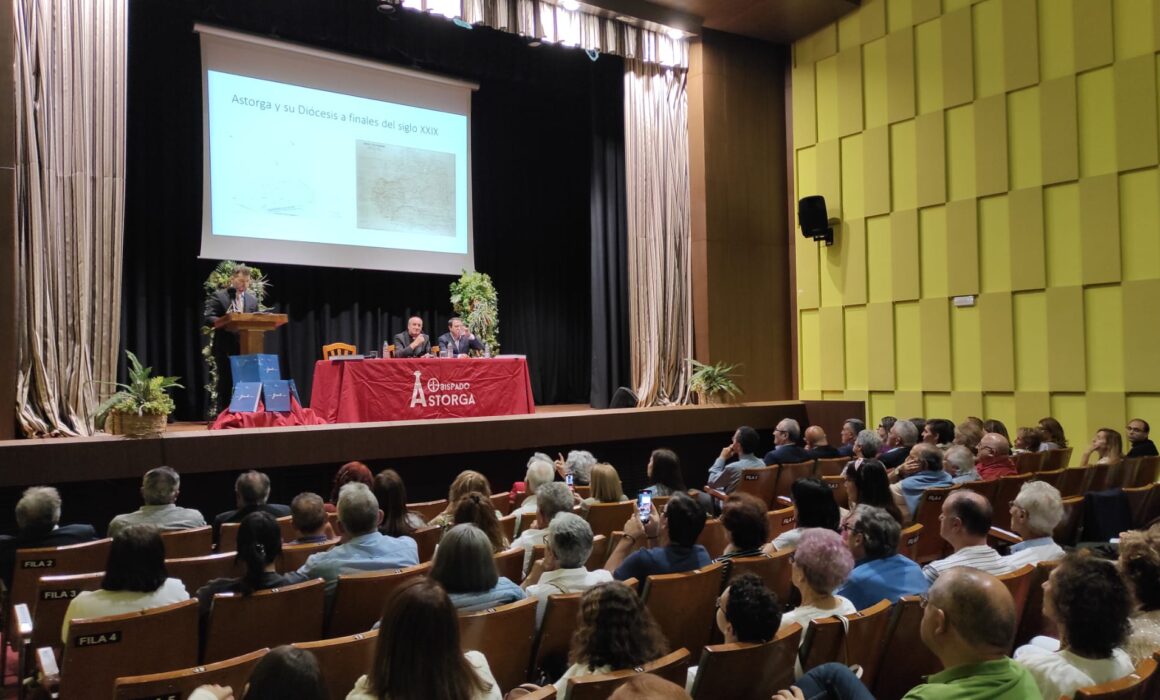
The Diocesan Theater hosted this Thursday afternoon the presentation of the book “Palacio Gaudí Astorga”, by Jairo Álvarez, a work fruit of years of research on the Episcopal Palace of Astorga, the most extensive and complete work of research dedicated to the Astorga monument, one of the three buildings designed by Antoni Gaudí outside Catalonia.
The event, which was attended by the subdelegate of the Government in León, Faustino Sánchez, the first deputy mayor Ángel Iglesias and the former mayors of Astorga, as well as civil, military and religious personalities, brought together more than two hundred people from Astorga and the surrounding area who were able to discover unknown facts about Gaudí’s Palace from the author of the book.
“110 years ago, the bishop of the diocese of Astorga at that time, D. Julián de Diego García y Alcolea with authorities and neighbors of our beloved Astorga celebrated something really important and that is that, after years of work and great difficulties, the works of the Episcopal Palace that D. Juan Bautista Grau had commissioned the great architect Antonio Gaudí were completed. Just as then, today we also meet to commemorate that event and to do it in a special way: giving the book that gathers its history and memory to our Gaudí Palace on its 110th anniversary”, began the act the director Víctor Murias. After thanking personally the presence and collaboration of religious, civil and military authorities, he expressed his respect for Mr. José Fernández, former director of the Palace and Gemma Quintana, niece of Mr. Augusto Quintana, first director of the Museum of the Ways of the Gaudí Palace.

After the intervention of the director who explained that “Palacio Gaudí Astorga” is a work of four years with 600 pages, 2150 footnotes of critical apparatus, 50 pages of bibliography and more than 300 photos, “some of them unpublished”. “The book has been made with love, care and dedication. We wanted the cover to be in itself a justification for having it; it is one of the plans that Gaudí designed for the construction of the Palace. I am personally very happy with the work and I hope that it will also be to your liking”, Murias ended his speech.
For his part, Jairo Álvarez, author of the book began his speech by highlighting the tourist importance of the Episcopal Palace of Astorga. “The attractions of this small city, caressed by the airs of the nearby Teleno, are many today in various fields. But among them all, the Episcopal Palace stands out. This has gone from being just one of the reasons to visit the capital of Astorga, to being the main one, the radiating center and magnet to attract Gaudinists and tourists”. “Astorga and León have two unique jewels of universal stature, known practically by all the inhabitants of the planet, which the rest of the cities do not have: the Way of St. James and a work of Gaudí”.

During the presentation of the book, Álvarez described the work of four years of research that today is condensed in a 600-page book with unpublished photographs and previously unknown information. “Continuing the work of our predecessors in the study of the Palace, especially María Jesús Alonso Gavela, and handling all the bibliography, we realized that the Palace, polyhedral, offers different readings. Among all of them, we have selected three, which correspond to the parts of this book. The first is the historical-constructive reading of the Bishopric; the second is the artistic and symbolic-spiritual reading; and, finally, the biographical reading, where we will focus on the ‘makers’ of the Episcopal residence”.
“In all these readings and various opinions, we have found two latent questions that we have tried to clarify. The first is the disjunction between Palace or Museum. We respond by saying that rather than ‘disjunctive’, it would be better to speak of ‘copulative’: Palace and Museum. Both complete and complement each other very well, a symbiosis and a perfectly matched marriage: neither the one discarded as an episcopal dwelling could have had a more noble and dignified destiny, nor this one could have had a more beautiful and elegant frame. The second lies in the ambiguity of the name, Gaudí Palace, since the fact that Gaudí abandoned the work without finishing it, has raised suspicions about whether it can be considered one of his works. According to architect Virginia González Rebollo, who has been directing the work on the Palace since 2013, the part not attributable to Gaudí does not exceed 25%. Based on this authoritative opinion, we can state with certainty that , the Episcopal Palace of Astorga is fully Gaudinian: “the fact that Gaudí left the direction before finishing it has meant that it is not given the category of others of his, but investigating and going into it you discover that it has more of Gaudí than was thought”, adds Virginia”.

The ceremony was closed by the Bishop of Astorga, Monsignor Jesús Fernández González, who today takes over the Diocese from Juan Bautista Grau y Vallespinós, who commissioned Gaudí to build the Palace. “I invite you to enter the book presented today “Palacio Gaudí Astorga”. The final result makes this work an obligatory reference when studying this extraordinary building that has come to ennoble our city. I take this opportunity to thank God for the Catalan artist, a man of deep faith, who wanted to capture in his work the beauty of God. I commend to the Lord those who have cared for and improved this work, especially the pastors who have shepherded this Diocese. I congratulate and thank all those who have cared for this work of art throughout history and those who continue to do so today. Thank you Jairo for the effort, dedication and scientific rigor with which you have worked. If anything has been clear, it is that it is a choral work, made by many people and institutions. We are receiving, without a doubt, a witness of faith made culture and culture soaked in faith. It is up to all of us to enjoy it, preserve it, improve it and make it known to future generations because Gaudí’s Palace glorifies God and makes Astorga and our Diocese great”.
The book will be available at diocesan bookstores, as well as at the Gaudí Palace store.