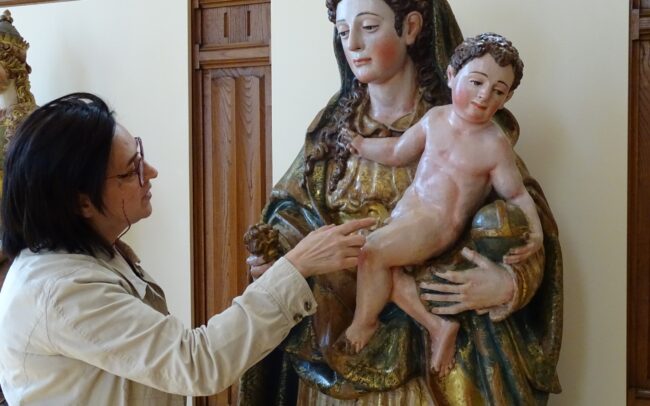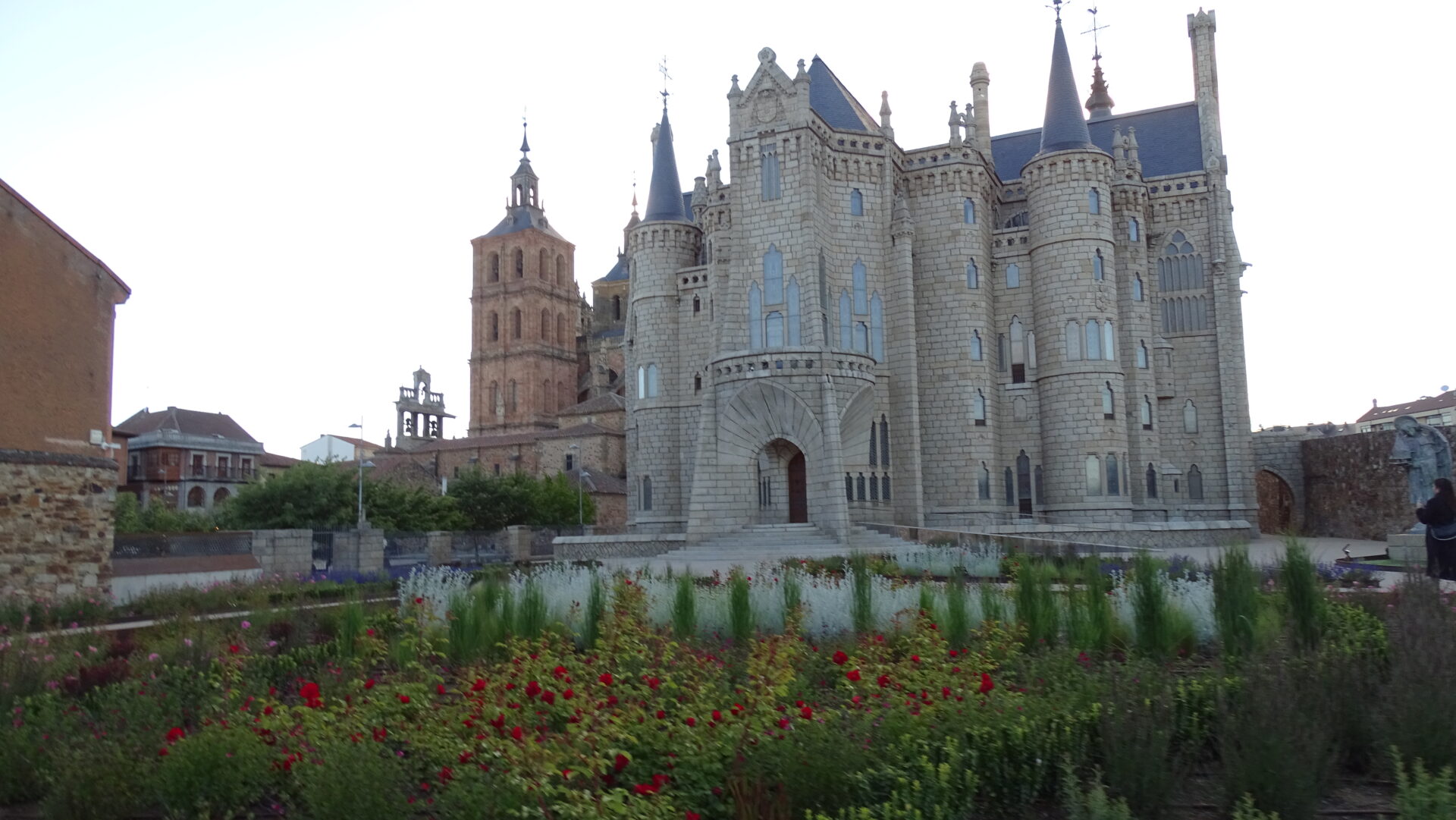
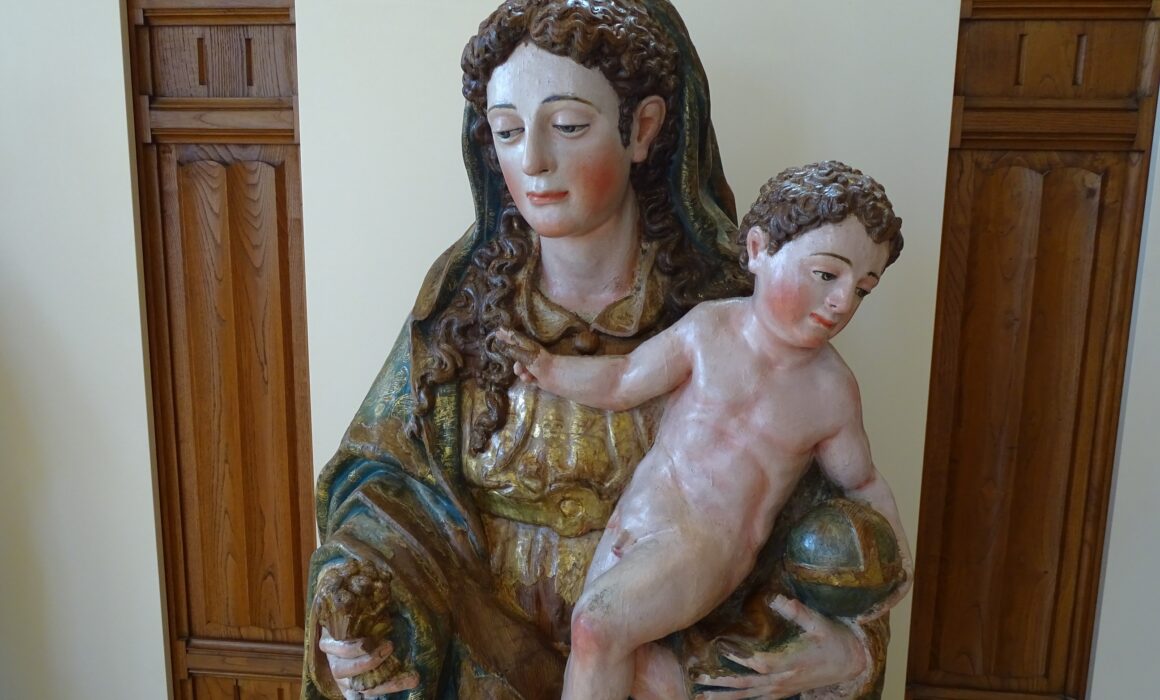
May is for the catholic tradition the month of the Virgin Mary. In her honor, the restoration of a polychrome carving of the Virgin and Child made by the sculptor Francisco de la Maza and originally polychromed by Cosme de Azcutia has been carried out. The image can be seen from this week in the fourth room of the main floor of the Museum of the Roads that houses the Gaudí Palace in Astorga.
The restoration process has been carried out by the Proceso Arte8 team and directed mainly by Luisa Castillo Vela. The wooden sculpture is dated 1579 and comes from the Monastery of San Esteban de Nogales. The restoration process is part of the work that Arte8 is carrying out with some pieces from the Gaudí Palace in its new museum project.

The recovery work on the Virgin and Child of San Esteban de Nogales is mainly aimed at stopping the deterioration that has caused dirt, numerous losses of volume and cracking of the paint, explains Luisa Castillo Vela. The piece is made by the sculptor Francisco de la Maza, an artist known mainly for his carvings in the Valladolid area and who is also credited with his participation in the main altarpiece of the cathedral of Astorga under the orders of the master Gaspar Becerra.
One of the peculiarities of the image that can be seen today in the Museo de los Caminos de Astorga is the existence of two polychromies that coexist in the same carving. It was Cosme de Azcutia who made the first polychrome, a work of great quality and detail that denote a work of art in itself. However, over the years, the wooden sculpture was again polychromed to preserve the original work of art. The dating of the polychromy is old enough to merit conservation.
Today, in Gaudí’s Palace, small traces of the original polychromy can be seen, a conservation intended to show both the original splendor and the current splendor of the work of art. On the face of the Virgin, as well as on the left arm of the child, the remains of the original polychrome can be seen under the second layer of polychrome.
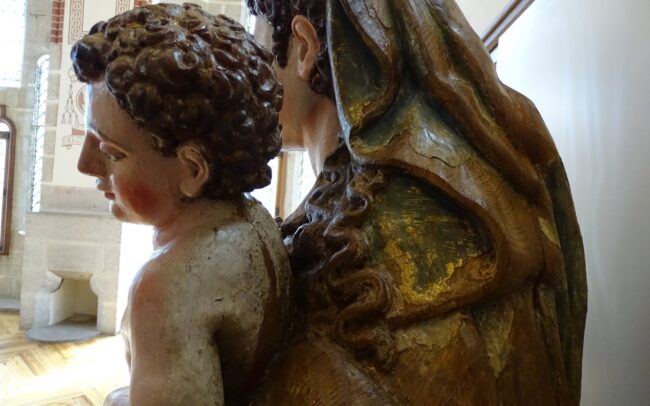
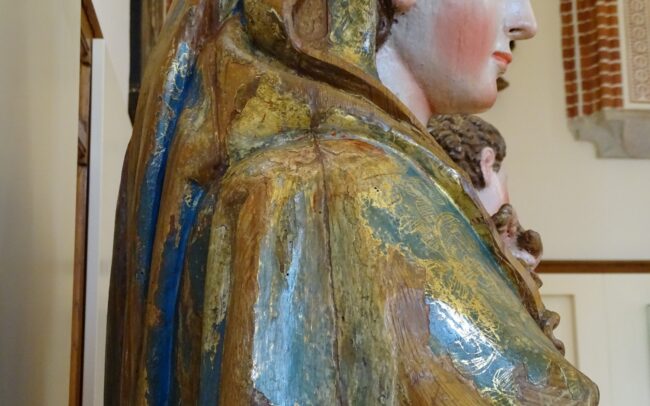
Another of the elements that keep the original polychrome of the image is the Virgin’s mantle, in the back of the carving we can appreciate the most intense blue of Cosme de Azcutia’s work, later covered by a greenish color. There are also traces of the original golden color both in the hair of the Virgin and in the hair of the Child Jesus, a color that was later covered by a chocolate brown tone.
Defects
Over the years, explains Luisa Castillo, the carving has been suffering the damages of time, such as loss of polychromy, lifting of the work and dirt adhered to the clothes of the Virgin, among others. However, one of the most serious has been to repair the damage caused by woodworm in the area of the base, as well as the large cracks in both the front and back of the image.
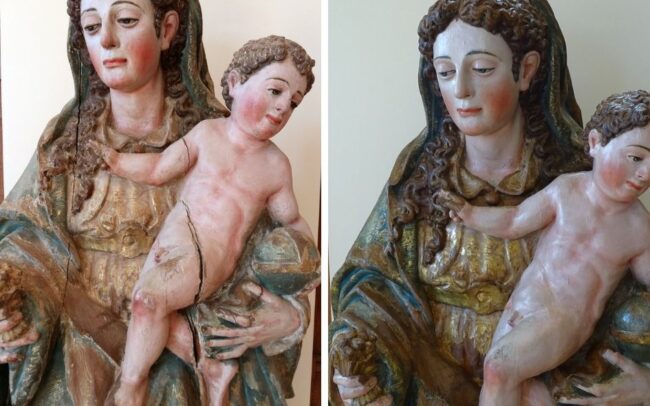
As can be seen in the image above these lines, in the area of the thigh of the Baby Jesus there was a deep crack and for the safety of the carving, so that the damage would not be greater, it has been repaired in the workshop that Luisa Castillo has on the second floor of the Gaudí Palace.
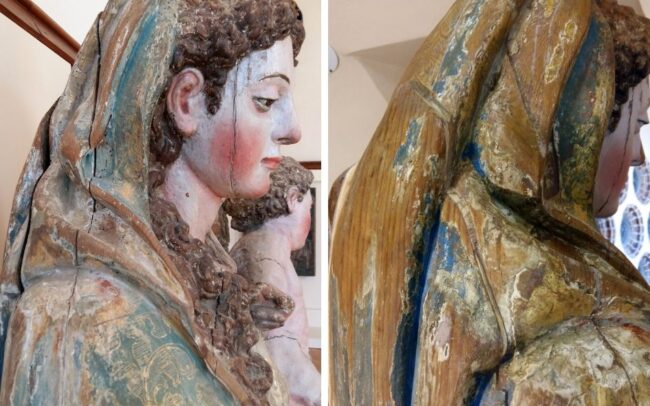
Above these lines, another image of the serious cracks that the sculpture suffered before being treated for its exhibition at the Museo de los Caminos, cracks that in the long run could deepen and lose the image without the possibility of recovery.
Another of the actions carried out was on the faces of the two figures that make up the 16th century carving. During the restoration process, the expert discovered that in both faces two noses had been superimposed that did not correspond to those of the original sculpture by Francisco de la Maza. The superimpositions have been removed and the faces have been restored just as the sculptor painted them on the wood.
The Virgin and Child has entailed a restoration process of three and a half months, a work that aims to show the work of art created in the sixteenth century by the sculptor without adding details or embellishing the materials, unlike what would be done with a piece that maintains its function in the worship of the Diocese of Astorga. The main objective has been to stop deterioration and repair damage that could eventually cause greater problems to the work of art.
For its restoration, the Arte8 Process team used reversible materials that were harmless to the work. Expert preparations with materials such as those used in the 16th century and water-based colors with natural pigments for the reintegration of the colors that had been lost. In addition, the process includes a glossy, matte and satin finish so that the work is protected and does not lose a glimpse of its original magnificence.