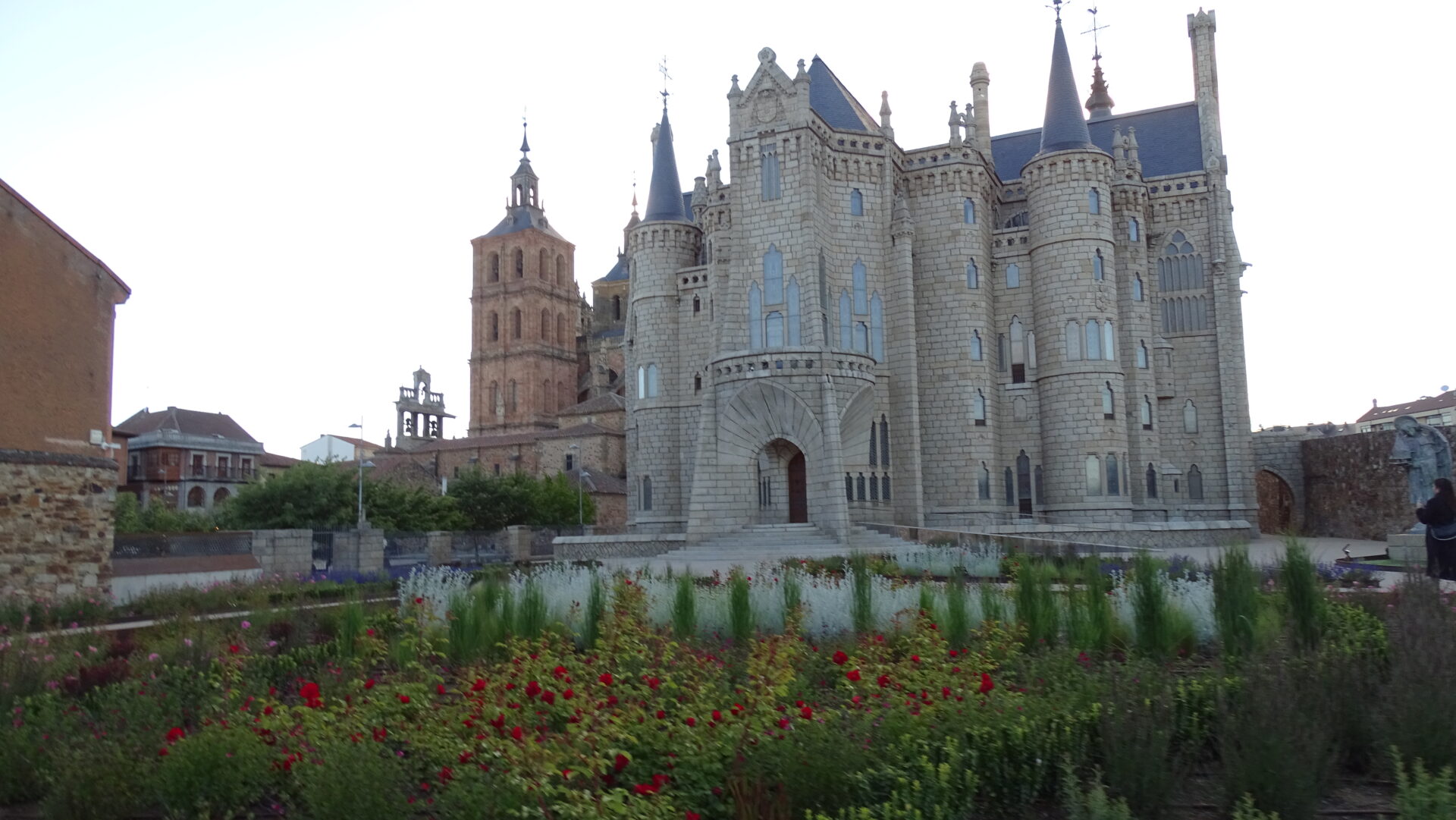
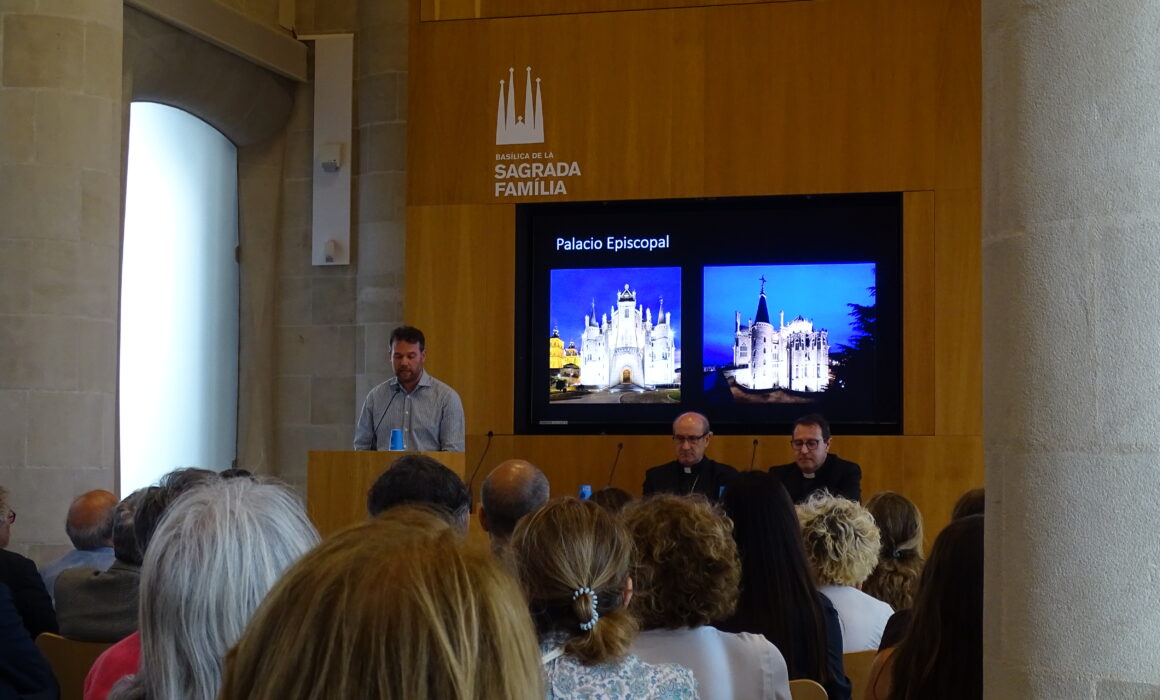
The Basilica of the Sagrada Familia hosted this Tuesday afternoon the presentation of the book Palacio Gaudí Astorga, by Jairo Álvarez, a work fruit of years of research on the Episcopal Palace of Astorga, the most extensive and complete work of research dedicated to the Astorga monument, one of the three buildings designed by Antoni Gaudí outside Catalonia.
The event, attended by the auxiliary bishop of Barcelona, Monsignor David Abadías, the rector of the Basilica of the Sagrada Familia, Josep María Turull along with members of the Construction Board such as the delegated president, the chief architect and the general director, as well as representatives of Gaudí’s other buildings (including Casa Botines in León and El Capricho in Comillas) and civil institutions, brought together more than fifty people who discovered a little more about the palace designed by Gaudí in Astorga. Monsignor Abadías was in charge of welcoming the event and introducing the delegation from Astorga. He highlighted the “rigor and effort” of the author Jairo Álvarez to “give us this gift that we can share between Astorga and Barcelona, today united by Gaudí”.

“In 1913, the bishop of the diocese of Astorga at that time, D. Julián de Diego García y Alcolea, with authorities and neighbors of Astorga celebrated something really important and that is that, after years of work and great difficulties, the works of the Episcopal Palace that D. Juan Bautista Grau had commissioned the great architect Antonio Gaudí were finished. We wanted to commemorate that event in a special way: giving our Gaudí Palace, on its 110th anniversary, the book that collects its history and memory. And we wanted to be present here in Barcelona on a very special date: today is the 172nd anniversary of Gaudí’s birth. A history that would not be possible without the concurrence, involvement and work of so many people and institutions. The bishops, the diocese, the administrations, the politicians, the architects, the directors, the different companies, professionals and workers who have made it possible to reach this point”, began the act the director Víctor Murias. After thanking personally the presence and collaboration of religious and civil authorities.
After the intervention of the director, who explained that “the book has been made with all the love, care and dedication. We wanted the cover to be in itself a justification for having it; it is one of the plans that Gaudí designed for the construction of the Palace. I am personally very happy with the work and I hope that it will also be to your liking”, Murias ended his speech. “Palacio Gaudí Astorga” is a four-year work with 600 pages, 2150 footnotes of critical apparatus, 50 pages of bibliography and more than 300 photos, “some of them unpublished”.

For his part, Jairo Álvarez, author of the book, began his speech by highlighting the union, with this act, of the only two works of Gaudí owned by the Diocesan Church, the Sagrada Familia and the Episcopal Palace of Astorga. He also highlighted the tourist importance of Astorga, among which “the Episcopal Palace stands out. This has gone from being one of the reasons to visit the capital of Astorga to being the main one, the radiating center and magnet to attract Gaudí and tourists”. “The Palace was mainly due to two people from Reus: the bishop Juan Bautista Grau Vallespinós, and the new architect Antonio Gaudí. Against all odds, enduring all kinds of problems, criticism and heartaches, as prelate and architect, they managed not only to raise the majestic Episcopal Palace, but above all, to establish a fruitful friendship that marked the young Gaudí forever”. United by a bond of origin, both from the Baix Camp de Tarragona, interested in archeology and the Renaixença movement, and “a symbiosis arose between them that seems to have been forged in the Catalan cultural sentiment that united them”.
During the presentation of the book, Alvarez described the relationship between Bishop Grau and Gaudi whose conversations “in union with the rubrics of the Roman Missal and those of the ceremonial of Bishops, framed in orthodoxy the growing religiosity of Gaudi, and taught him that Christian art is at the service of the liturgy, that art is not an end but a means, an offering to the Lord”. “But if Gaudi discovered in Astorga a concern for spirituality and liturgy, we must indicate that his concern for the world of the workers also grew. The hierarchy of the Church saw with impatience the rise of the workers’ movement and the lack of guidelines for their care and attention because of the novelty it constituted”.

He described the work condensed in the book “Palacio Gaudí Astorga” and concluded his speech by pointing out that “the Palace is not the son of a specific era, since its construction and decoration has differed over different and successive decades. Therefore, we can say that the new Bishopric of Asturias has been chameleonic. It has been and is a living building, with the capacity to adapt to all the destinies and works that have been thought for it, with hardly any resistance to those changes, and that in spite of its sinuosity and structural complexity”.
The ceremony was closed by the Bishop of Astorga, Monsignor Jesús Fernández González, who pointed out that “the relationship between Catalonia and Astorga has been prosperous and fruitful, sustained by historical events such as the Reconquest, and cultural and religious events such as the Camino de Santiago, gaining in intensity especially since the end of the 19th century and throughout the 20th century. In October 1886 Bishop Grau Vallespinós arrived in Maragata. He has been succeeded by a series of Catalan bishops who have contributed to the improvement of the Asturian bishopric and its people throughout the 20th century. We can say that a fundamental backbone of this special bond has been and continues to be the Gaudí Palace, forever linked to the efforts of some bishops”.

In this regard, he referred to the Catalan bishops who have passed through the Palace, as Castelltort who decided to continue the works in the Palace to convert it into housing or Monsignor Marcelo Gónzalez Martín, auxiliary bishop of Barcelona and, later, archbishop, who decided to open the palace to the public as the Museum of the Roads and Monsignor Antonio Briva Mirabent who concluded to reside in the Seminary of Astorga to leave the Palace as the seat of the Museum. “In 1989, on the occasion of the centenary of the laying of the first stone of the Episcopal Palace, there was a twinning between the cities of Reus and Astorga. Finally, I would like to point out that, between February 20 and May 20, 2018, the exhibition “Gaudí and the Sagrada Familia. An inner experience”, thanks to which it was possible to sign an agreement with the Junta Constructora del Templo Expiatorio de la Sagrada Familia Foundation. The inauguration was attended by Cardinal Omella, the delegated president of the Construction Board Esteve Camps and the general director Xavier Martínez. Since then there has been a magnificent relationship of collaboration between the two dioceses and the two works of Gaudí, a relationship that we hope will continue in the future”.

Cultural Visit and Commemorative Mass in the Crypt
The bishop of Astorga, Monsignor Jesús Álvarez, celebrated at 9 am a Eucharist in the Crypt where the Catalan architect is buried, remembering the 172nd anniversary of Gaudí’s death. The ceremony was presented by Mosén Josep María Turull, rector of the Basilica, and was attended by a large number of people.


After the celebration, the Asturian prelate signed the Book of Honor in the Sacristy of the Basilica and was guided on a cultural tour of the Sagrada Familia accompanied by the director of the Palace and the author Jairo Álvarez. Mosén Turull guided the Asturian delegation through the architecture and history of the Barcelona monument, portraying the legacy of the architect Antoni Gaudí.